When schools across the country shut down during the 2020 COVID-19 pandemic, many students were relieved and ecstatic to have a break from having to walk through the halls and sit in class. This break quickly led to irreversible consequences nationally, however, in the forms of learning loss, lower test scores, and plummeting grades.
On March 12, 2020, a Thursday afternoon, the Montgomery County Office of Health notified Spring-Ford Area School District that all schools in Montgomery County would close for a minimum of two weeks. A day later, then-Gov. Tom Wolf declared a mandatory shutdown of schools in the state that eventually extended the rest of that school year.At Spring-Ford that spring, students finished the school year working remotely on Google Classroom, unsure of when they would return.
The following fall students returned virtually, then via a hybrid method in November, then to a four-day, in-person reality, in February of 2021, before returning to in-person, traditional five-day weeks during the 2021-22 school year.
The gap represented nearly a year-and-a-half of interrupted traditional learning. The impact of that time away for students locally and nationally turned out to be profound.
Some simply were unable to keep up due to that gap of traditional learning, leaving those students in a free fall academically.
The Academic Recovery Scorecard, a study created by researchers at Harvard and Stanford Universities, says the recovery of students varies drastically state by state, according to a New York Times article of their latest report. School children in Massachusetts, Ohio and Pennsylvania were still about half-year behind typical pre-Covid reading levels, for example. Other states were three quarters of a year behind, and some states were an entire year behind.
Academic researchers in the article found “disappointingly slow recovery in almost every state. School closures during Covid set children back, and most districts have not been able to make up the lost ground.”
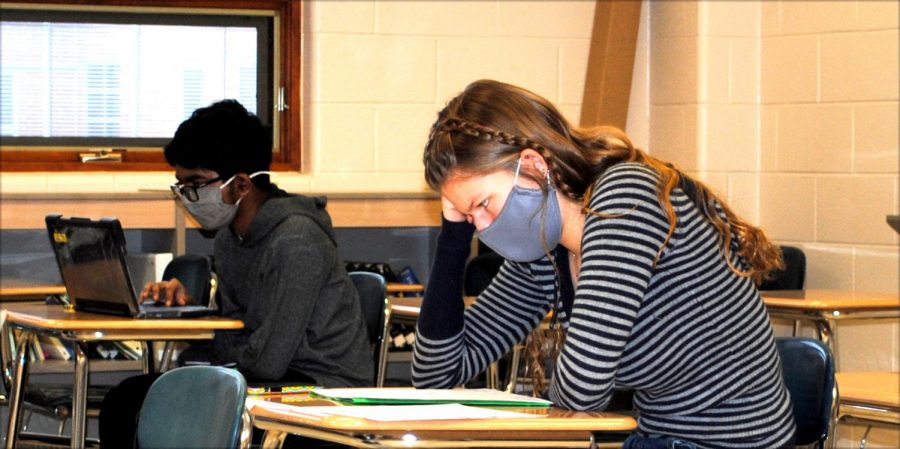
Students at Spring-Ford were among those feeling the effects from the shutdown, experiencing grades dropping, feeling left behind, and not being able to grasp material taught during the online period.
“I was learning less during remote learning,” said senior Janise Hong. “In seventh grade when it was fully online, I felt like I had to catch up.”
With students forced to learn from screens at home, the structure of day-to-day, in-class learning was not easily replaced.
“(The pandemic and online learning) decreased participation, decreased classwork/homework completion, and led to sleeping during class,” said Spring-Ford science teacher Heather Woznicki, adding that students “lost communication skills, the ability to make eye contact, and had decreased maturity levels. For at least a half-year period after coming back, it was like relearning how to do school.”
Many students sorely missed the structure of checking in day-to-day.
“I would miss my first period class and be unfocused,” senior Abhi Attili said. “Just waiting to go to the next class.”
In addition to a lack of in-person education, absenteeism proved problematic nationally, and has persisted.
“The pandemic may have been the earthquake, but heightened absenteeism is the tsunami and it’s still rolling through schools,” Thomas Kane, a Harvard economist and a member of the research team, said in the Times article.
Researchers pointed toward after-school tutoring and summer school, subsidized by federal aid, as making a big difference in student success, as was increased efforts to reduce absenteeism. Spring-Ford made both of those academic interventions available when students returned.
The study in the Times article and the performance of most schools, including Spring-Ford, clearly show that the pandemic’s effect on academics did not end when students returned back to school. In many ways, it just started to begin.